Short answer: no. FOMO does not have a copy trading feature. Its help centre answers the question directly, in an article titled “Does fomo have copy trading?” published 19 May 2026:
“fomo does not have a copy trading feature. What fomo does offer is full transparency. Every trade on the platform is visible in a real-time social feed, you can follow any trader to track their activity, and the leaderboard ranks everyone by actual performance.”
Every trade shown to you is still a trade you place yourself, by hand, at the same fee as any other order. This page covers what the feed, follow and leaderboard actually do, how to act on a trade you see without any automation, and what that costs.
Independent affiliate guide. We may earn a share of trading fees through our code. Product instructions are based on public documentation unless a specific observation is labelled. Evidence and limits.
what the feed, follow and leaderboard do
FOMO does not have a copy trading feature, so nothing on the app mirrors another account's trades for you. Three separate features stand in for it, and each does one honest job.
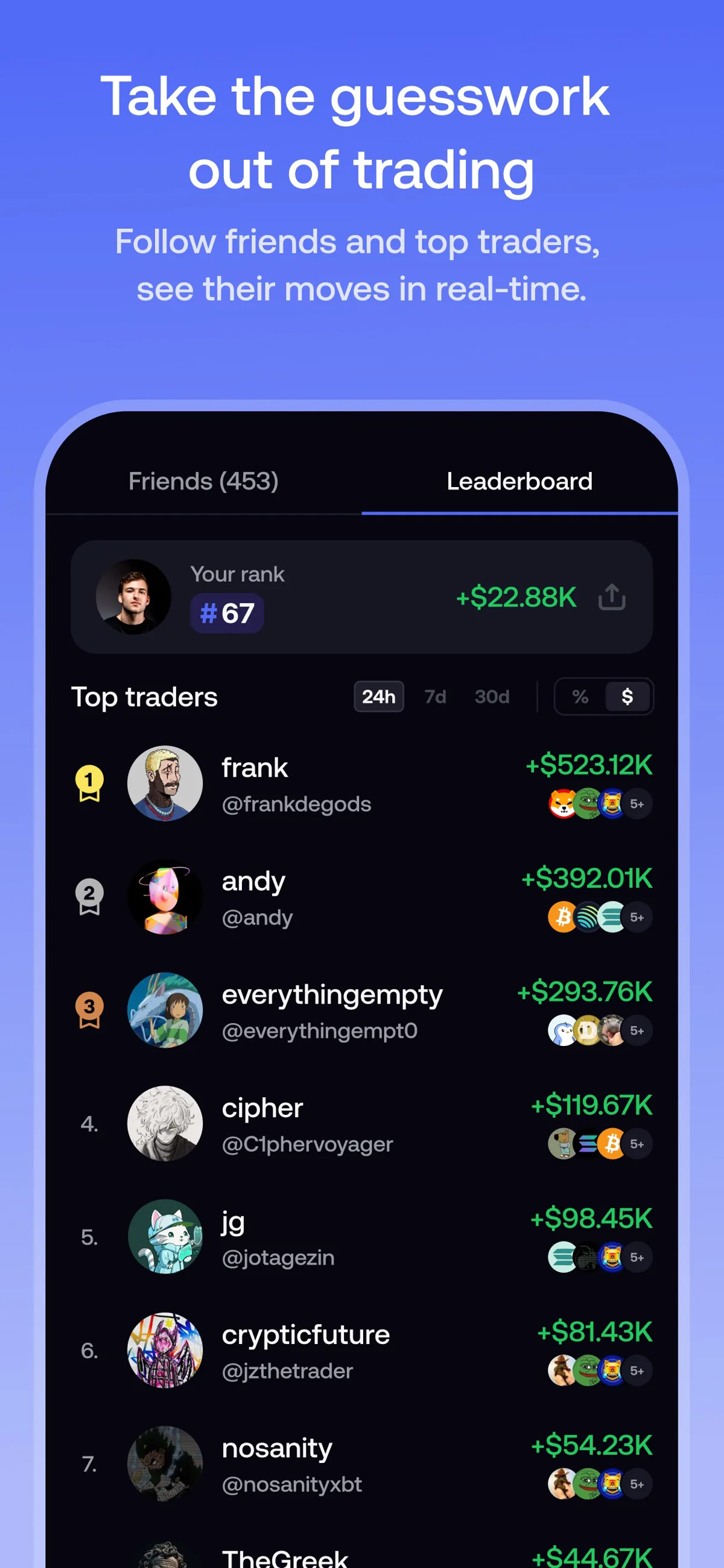
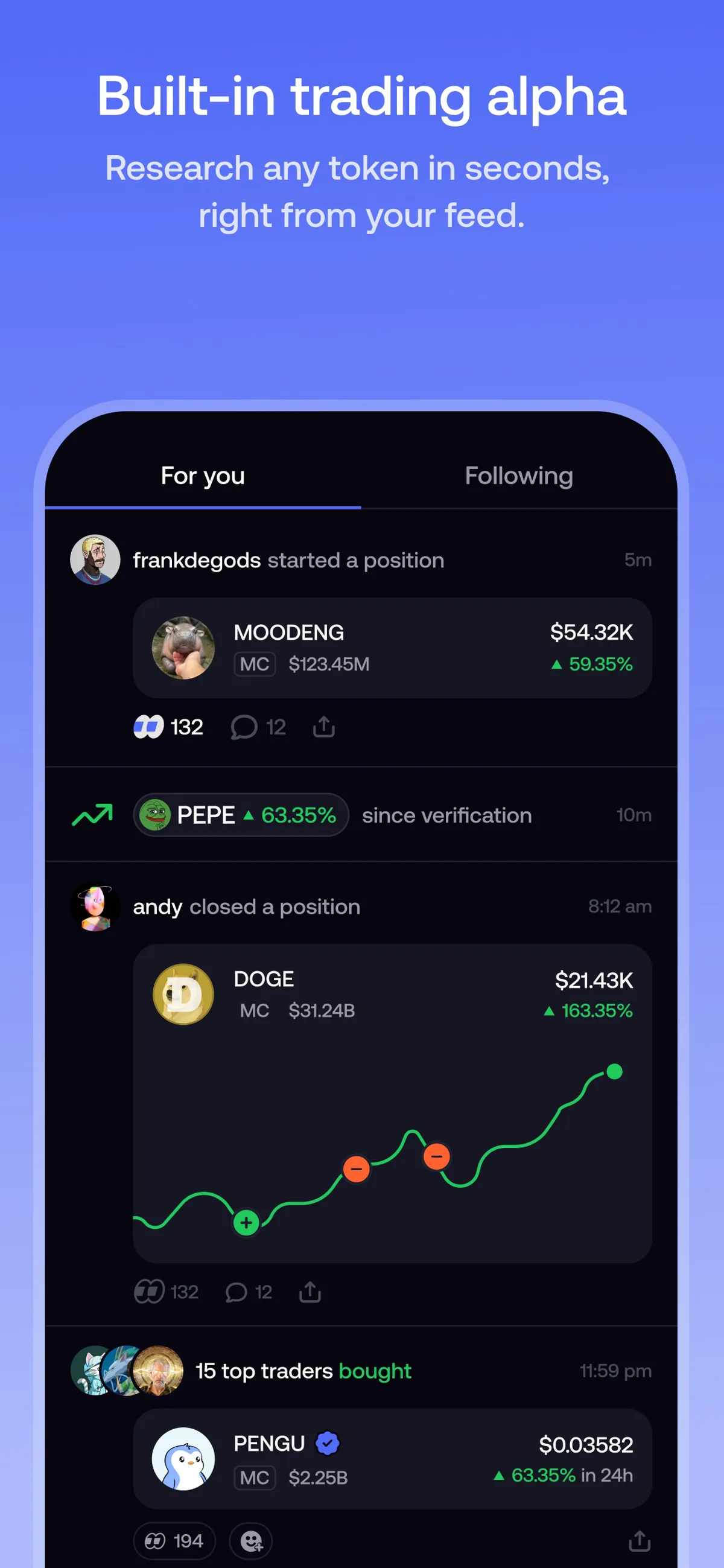
- The feed shows every trade on the platform in real time: who opened or closed a position, in which token, and at what size.
- Follow lets you track a specific trader's activity so their trades appear in your feed. Following costs nothing and does not place any orders.
- The leaderboard ranks every trader by realised profit over 24 hours, 7 days or 30 days. Ranking is based on actual results, not projections.
Together, those three features give full transparency into what other people are trading. None of them execute a trade on your behalf.
how to follow a trader's trade by hand
Acting on a trade you see in the feed takes three manual steps, and FOMO treats the result as an ordinary buy, not as a copy of anyone else's position.
- Open the feed or the leaderboard and find a trade from a trader you follow.
- Tap the trade to open that token's page.
- Buy the token yourself, in your own amount, and confirm the order. FOMO does not set your size to match theirs.
Sending funds directly to another user's account is a transfer, not a copy trade. A transfer moves money. It does not open a matching position, and it does not appear anywhere in the app as a “copy”.
Referral code
VIP10
FOMO's published offer: 10% off trading fees
Trading anyway? Pay 10% less with VIP10 →FOMO documents a reduction from its standard 0.50% fee to 0.45%. Duration and discounts on other fee bands are not specified. The public VIP10 page displays this offer; account acceptance has not been independently tested here. Check the fee in your account. Terms can change.
Independent affiliate guide. We may earn trading-fee commission if you use our code.
what a followed trade costs
A trade you place after following someone pays the exact fee schedule on FOMO's fee page: on Solana, orders under 190 USDC pay a flat or banded fee, and orders of 190 USDC and above pay 0.50% per trade. A complete trade is charged twice, once to open and once to close.
| Order size | Fee per leg | Round-trip cost | Round-trip as % of order |
|---|---|---|---|
| $50 | $0.95 | $1.90 | 3.8% |
| $100 | $0.95 | $1.90 | 1.9% |
| $500 | $2.50 | $5.00 | 1.0% |
| $1,000 | $5.00 | $10.00 | 1.0% |
A $50 order pays the flat 0.95 USDC fee on each leg, so the round trip is $1.90, or 3.8% of the order. A $1,000 order clears the 190 USDC line and pays 0.50% per leg, so the round trip is $10.00, or 1.0%. The 10% referral discount lowers the 0.50% rate to 0.45%, which brings the $1,000 round trip down to $9.00. FOMO's help centre documents the discount against the 0.50% rate only, and does not state whether it also applies to the flat and banded fees under 190 USDC. The profit calculator runs the same maths on any order size you enter.
reading a profile before you follow it
Leaderboards rank realised profit, and realised profit over a short window selects for survivors: the trader who put everything on one token and won ranks first, and the identical account that did the same and lost is not on the board to warn you. Before following anyone, open the profile and check four things.
| Check | Good sign | Warning sign |
|---|---|---|
| Time window | Profitable over 30 days, not one day | One huge 24-hour spike |
| Trade count | Many positions, modest sizes | One or two all-in trades |
| Exits | Closes positions both ways | Only opens show, exits missing or late |
| Tokens | Named tokens you can verify | Fresh launches they might control |
The last row deserves its own sentence: a profile that keeps “winning” on tokens minutes after launch may be trading its own deployments, and buying in after them makes you the exit liquidity. Check unfamiliar tokens against DexScreener before you buy.
three signs a leaderboard run is luck
- The profit arrived in one trade. A single 40x on a fresh launch ranks an account for a week. It carries no repeatable information, and the identical account that missed by one token is invisible.
- The size went up right before the streak ended. Winners tend to escalate. A profile whose recent trades are much larger than the ones that built the record is showing you the end of a run, not the start of one.
- Everything is the same narrative. Ten wins in one token category is one bet made ten times. When the category turns, the whole record turns with it. Consistency across time windows means more than any single number on the profile.
why people still call this “copy trading”
The feed makes it fast to act on a trade the moment someone you follow makes it, and speed is what people associate with the term “copy trading”. FOMO's own help centre rejects the label. Following, the feed and the leaderboard are real features. The automatic mirroring that the term implies does not exist on FOMO. Every order still needs your own tap to confirm it, at your own size, and it pays the same fee as any other trade covered on the ways to earn on FOMO.
FAQ
Is copy trading on FOMO automatic?
It does not exist, automatic or manual. FOMO's help centre states plainly that the app does not have a copy trading feature. Following a trader shows you their trades. Acting on one means opening the token page and buying it yourself.
Does following a trader cost extra?
No. Following and the feed are free. A trade you place after following someone pays the same fee as any other FOMO trade, shown in the table above.
Can I send money directly to a trader I follow?
Yes, but that is a transfer, not a copy trade. It moves funds from your account to theirs. It does not open a matching position in your account, and FOMO does not track it as a copy of anything.
Is following traders on FOMO good for beginners?
Watching how experienced traders enter, size and exit positions teaches faster than most articles do. Buying in after them with real money, before you understand the fee table above and the survivorship problem in leaderboards, usually costs more than the lesson was worth. Read the safety page before funding more than you can afford to lose.
Does the referral discount apply to trades placed after following someone?
Yes. The 10% fee discount from a referral code applies to every eligible trade on the account, including one placed right after following someone in the feed. The code can only be added during signup.
Related: how buying works on FOMO, every way to earn on FOMO, ranked, the six chains FOMO supports, and the full review, including where this feature gap fits in the verdict.
Sources and dates
These sources support the documented claims. A public-source check does not verify account acceptance or a completed trade. Historical observations retain their original dates. Read the evidence limits and corrections.